Evolving Technology and Inequality, The Modern Day Circumstances of Students in Chicago

A CPE Website by Simeon Nedev

In today's landscape, students across the world live in a rapidly changing world. Most recently, the world has rapidly progressed with electronic technology by developing computers, phones, the internet, and artificial intelligence. Since the 1980s, schools have integrated computer technology into their education, enhancing student motivation and attendance (Muir-Herzig, 2004, p. 4). In our modern times, classrooms are integrating AI education, in hopes of developing tailored educational systems for students ranging from special education and language processing to robotics and data analysis (Dimitriadou & Lanitis, 2023). With this new AI technology, many concerns have been brought up by teachers, students, and parents on academic integrity and overreliance on AI as an educational tool (Lee et al., 2024, p. 1). Since its release, generative AI has pushed educators to rethink the very structure of their classrooms and the curriculum they teach (Karataş et al., 2024, p. 4). While technology is prevalent in education, these benefits may not all be equally reaped, especially in the City of Chicago. Governed by their experience with AI and tech, some individuals and students may disproportionately be offered different realms of opportunity and success.

Disproportionate Academic Opportunity in Chicago

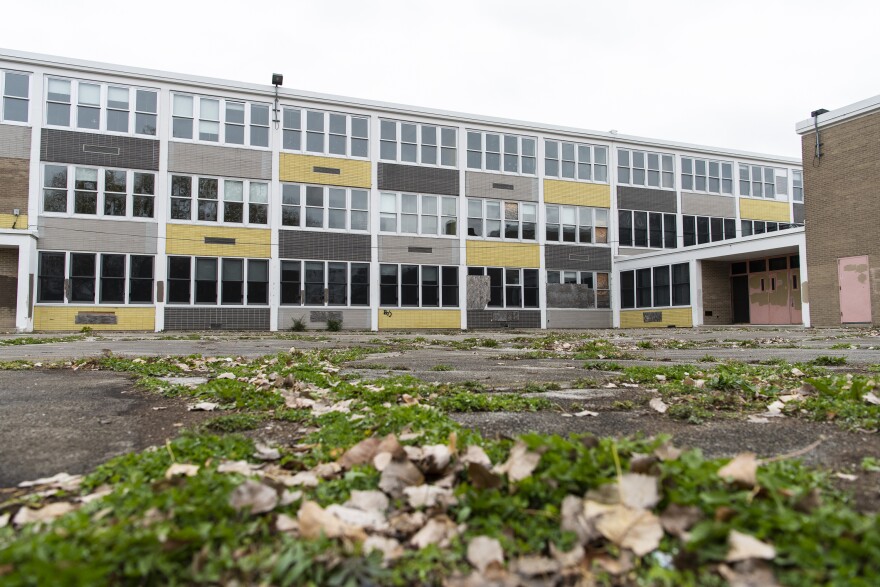
With 316,224 students and 630 different schools in its school district, Chicago Public Schools District (CPS) is the 4th largest School District in the United States. While CPS receives 8.6 billion dollars of funding a year, all these funds are not equally allocated (Chicago Public Schools, 2023). In May 2013 CPS decided to "close 49 elementary schools and one high school program located in an elementary school, the largest mass school closure to date. To accommodate the nearly 12,000 displaced students" (University of Chicago Consortium on School Research, 2018, p. 3). This decision was made with the idea of "cost savings", however, these closures "disproportionately affected schools located in historically disinvested and primarily Black neighborhoods, with many of the schools' serving areas of the city with high unemployment and crime rates" (University of Chicago Consortium on School Research, 2018, p. 3).

Many of these students in these communities are disproportionately affected by poverty and crime, experiencing segregation from other communities. As a result, education across neighborhoods differs in quality. Students in neighborhoods with crime and poverty have less access to resources and spend more time repeating lessons than middle-class students (Rothstein, 2014, p. 1-2). These differences in educational quality and resources became more apparent through the COVID-19 Pandemic. In September 2020, 110,000 Chicago students did not have access to broadband internet, resulting in CPS distributing electronic devices to students, devices that were often of poor quality or did not last long (Chicago Teachers Union, 2022).

Furthermore, the neighborhoods of Englewood and Austin lacked proper internet access compared to their north side counterparts. Despite operating within the same school district and city, Chicago students are presented with very different realities in education. This effect is known as the "digital divide" in which individuals who can effectively use new information and communication tools, such as the Internet, and those who cannot are differentiated (Afzal et al., 2023, p. 5). The existence of such a gap only supports the existence of different curricula for different groups of people, curricula that shape the very thoughts and pathways of students.
School closing in Chicago
School closed in Chicago (2013)
Hidden curriculum concept
Hidden curriculum shapes workforce expectations

The Hidden Curriculum for Students

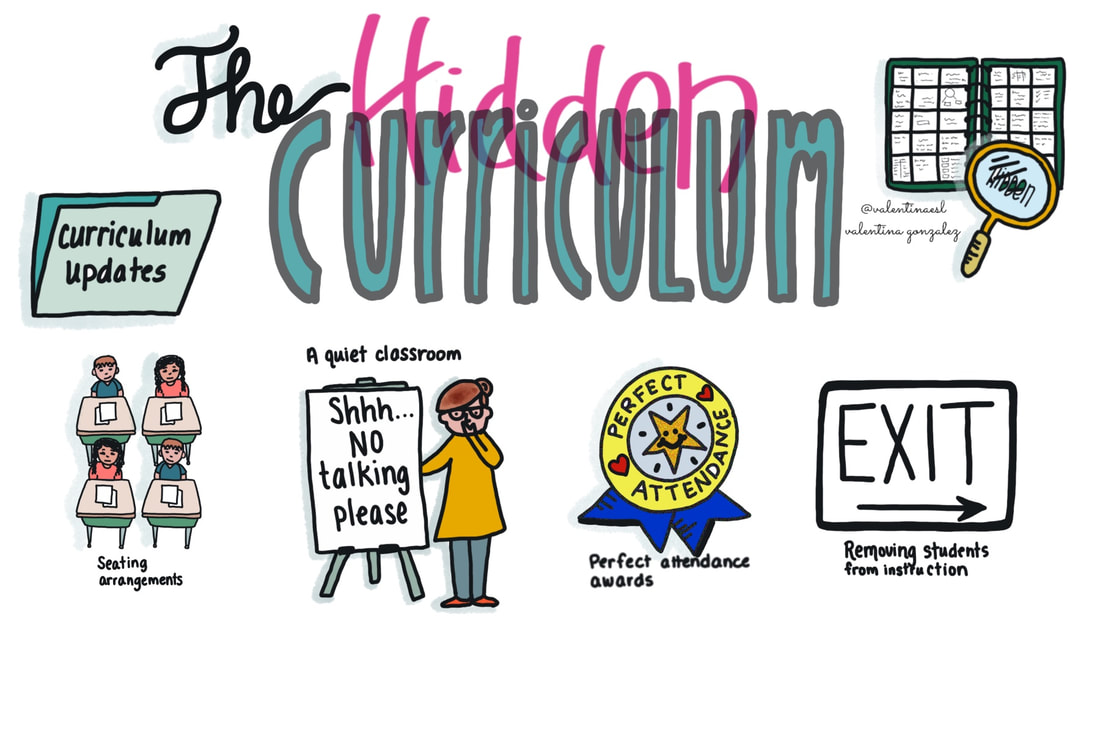
As the digital divide continues to exist, so does the different curriculum and expectations for students. Rooted in curriculum theory, there may exist a hidden curriculum that is not explicitly taught or stated by educational institutions. Hidden curriculum is a type of curriculum outlined by curriculum theory which is the study of curriculum as a social practice, the organization of knowledge, the various stakeholders in curriculum, and the social interests and power dynamics in curriculum (Scott, 2001). Hidden curriculum is the discrepancy between what is taught in schools and what is not taught and what "kinds" of students get to access certain "kinds" of knowledge (Apple & King, 1977, p. 6-8).

For lower-class students, not having the same access to technology as students in middle-class neighborhoods and upper-class neighborhoods is an example of the hidden curriculum. Students in lower-income areas have education that is less centered around how to use technology, AI, and the internet. This lack of education fails to develop a strong foundation in computer and internet skills. In turn, these students may feel that computer skills are not as important to their education as their middle-class neighbors.

The structure of school life, and the basic organizing framework of rules, gives meaning to the experience of students in educational institutions, being closely linked to deep structure of school life, this experience is closely linked to the structure of industrial life and workforce (Apple & King, 1977, p. 15). By creating these feelings in students and not providing equal access to technology, the curriculum, and the organizations that structure curriculum, set up students to conform to different standards of the workforce and industrial life. Middle-class students are the "kinds" of students that get to work with computers, gaining skills that set them up for white collar work, while lower-class students are the "kinds" of students that work with their hands, setting them up for work that may not be aligned with computers. As this hidden curriculum and lack of equal technology access continues to exist, the gap and opportunity for students may widen with the existence of AI.

Personalized tutoring and the Hidden Curriculum of AI

Since the release of Open-AI's Chat-GPT, the global AI craze took the world by storm, ushering a new era of AI integration into every facet of the digital world. Consequently, AI became easily accessible to students and as a tool, has dramatically shaped education. Due to its abilities to generate content, solutions to problems, and essays, the educational landscape had to shift to adapt. Since its release, generative AI and artificial intelligence has been adopted as a tool to tailor educational content to the many different needs of students (Karataş et al., 2024, p. 3). AI technology has been utilized to rapidly generate new learning materials for students, along with personalized feedback, allowing more time for students and teachers to collaborate (Karataş et al., 2024, p. 3).

However, not all students have the same knowledge of AI. In a 2023 study, familiarity with AI tools increases with income level and is better known by White teenage students than Black and Hispanic teens (Lee et al., 2024, p. 7). With these advantages of AI, many students with a lack of technology access miss out on the experience to gain a personalized education that can suit their dynamic needs. This can especially hurt students with special needs and learning disabilities in low-income areas that may benefit from a personalized educational tool.

Since its release, AI skills are starting to show up in job listings with 74% of listings mentioning AI (Stahle, 2025). By not gaining experience with AI in schools, and by looking for AI skills, employers are singling out a large portion of low-class, low-income students from easily obtaining certain positions. As a result, company hiring shifts to the upper and middle classes, leaving the low-class, low-income students not worthy of employment. The hidden curriculum continues to teach low-class, low-income students that they may not be worthy of skilled careers and tailor-made educational content.

Artificial Intelligence technology
AI as Technology in Education
Declining exam scores graph
Declining exam scores since 2012

Cheating with AI and Falling Exam Scores

While AI can serve as an educational tool that supports student learning, there may be other implications of its use in classrooms. In a recent 2023 study, many students have admitted to using AI to complete assignments, edit portions of papers, and to generate computer code with public high school students leading over private high school students in use (Lee et al., 2024, p. 6). Many of these behaviors could traditionally be considered cheating as students don't fully incorporate their own work in their assignments. Since this study, the use of AI has grown in education and the workforce along with its capabilities. With developments in AI, it can be a concern to parents and educators on whether their students are learning or cheating through school.

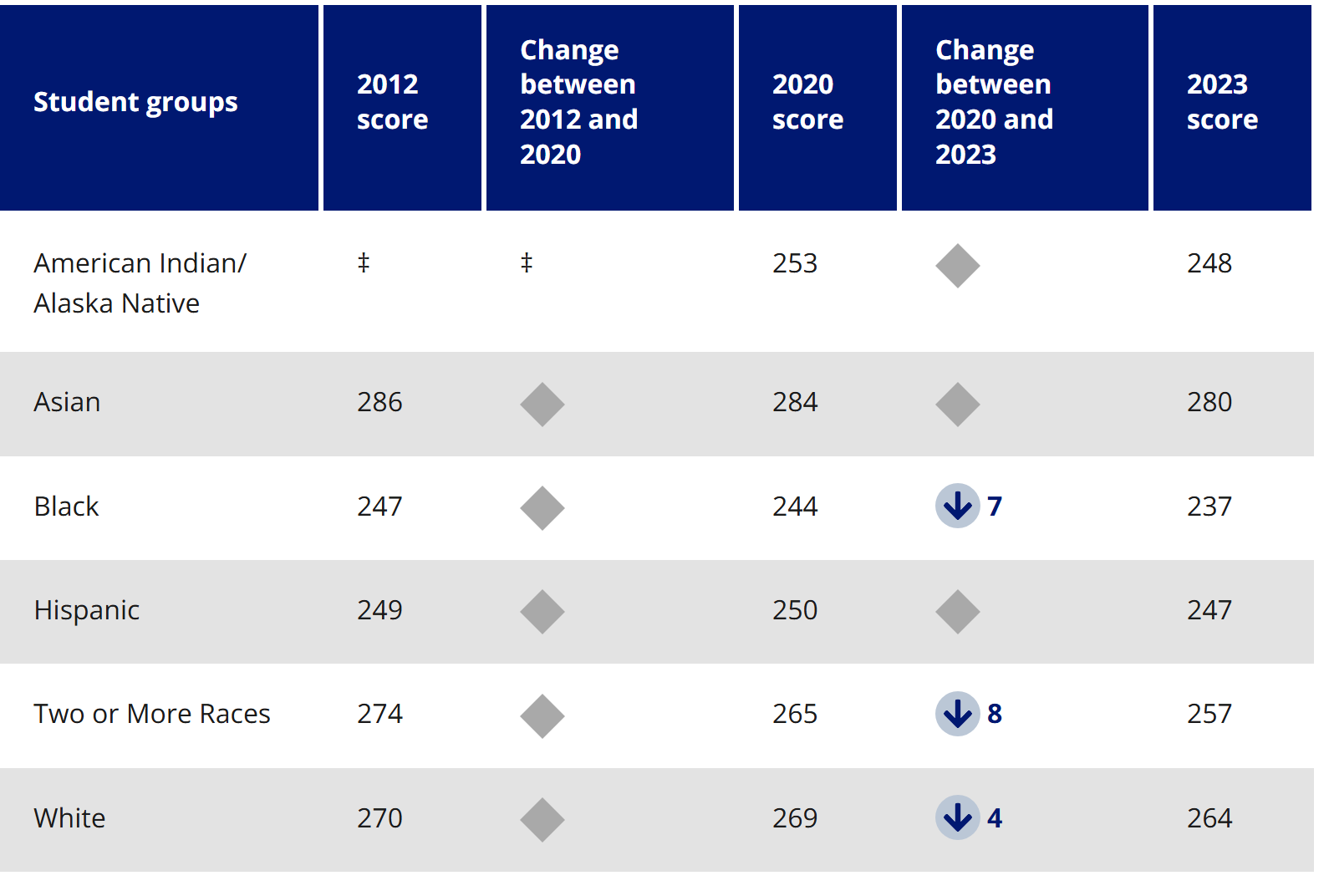
These concerns are further backed by the decline of scores in reading and math since 2012 (National Center for Education Statistics, 2023). Students have also reported lower engagement with reading and algebra with only 14% reading for fun, and 24% taking algebra, in 2023, as opposed to 34% in 2012 (National Center for Education Statistics, 2023).

While there may be many different reasons for the drop in scores, there is evidence to suggest that technology may play some part in the drop. Some studies suggest that laptop use in class can serve as a distraction from classroom material for students (Dontre, 2021, p.4). During class time, students may find it difficult to avoid browsing the internet, shopping, or watching YouTube videos. While there are some stopgaps to limit these behaviors, students may still have the tendency to be distracted in their learning environments. Technology can bring many benefits to classrooms; however, its adoption and use may have to be reconsidered in certain classroom settings.

The Future Ahead, helping Students Overcome the Educational Gap in Chicago

Despite the long-lasting presence of these educational gaps, income gaps, racial inequality, and technological inequality, new policy and methods of intervention are being deployed to ensure students among different neighborhoods, classes, and races can have equal educational opportunity. One such method would be the expansion of housing voucher systems. In a 1990s study, New York City implemented a program named MTO in which students and families were given vouchers to help move from lower income areas to higher income areas, resulting in safer schooling for children and better academic performance (Leventhal & Brooks-Gunn, 2004, p. 16). While these vouchers may be a band-aid solution in solving the overall segregation issue in schools and inequality, such programs allow families to get the needed help to move out of dangerous or low-income areas into higher income areas. Furthermore, by scattering low-income earners around neighborhoods with the use of vouchers, the achievement gap between income and races may be reduced as every group of individual gains access to more equal resources (Rothstein, 2014, p. 8). Voucher systems can help the life and education of students outside of school, however, there are some things that can be done inside of schools to help. Increasing funding equity and training for teachers can help teachers develop and adapt to curriculum (Slavin, 1999, p. 10). By supporting funding equity, teacher workshops, and increasing funding for teachers, educators across different schools within the same district will be given the same resources, letting students across different neighborhoods and schools receive the same curriculum. Above all else, bringing attention to the educational gap in Chicago and the unequal access of technology and AI education, along with its use cases, can create the movement for change. To make change and progress through policy, the public and policy makers need to be more aware of the educational circumstances and inequalities students face (Rothstein, 2014, p. 8). Without the support from the public, it will be difficult to pass laws and policy that can get the necessary funding and attention to even out the educational circumstances of students in Chicago and the broader United States.

Housing voucher program
Housing voucher programs and funding equity

About Me and Why this Topic

This website was created for my Culture, Power, and Education class as a final project. To me, this project represents my connection to education as a whole. As a mathematics and computer science major, I often work with technology and learn how it operates on a deep level. To some degree, I became disconnected from the reality of education and how prevalent technology may or may not be in the K-12 curriculum. This perspective of mine shifted during my time in my Money, Power, and AI course, along with my Culture, Power, and Education course. Taking the money, power, and AI course taught me to think critically about the technology in the world around me and the power associated with AI. I grew to look at artificial intelligence as a technology that can alter the education and power structures that have existed in the world. My course in culture, power, and education taught me about the inequalities that exist in the education system and the city of Chicago. The unequal access to resources and the opportunity of growth. I began to look into how current day technological advancements can affect current and future students. Through readings by authors like Rothstein, I grew to understand that a lot of segregation and current power structures are a result of policy implemented upwards of 40 years ago. These policies, along with the current stance of the United States government that the current racial and educational inequalities are defacto, still affect students and their circle of opportunity. With these two classes and my new perspective, I decided to create a website, that can easily be accessed, to give my perspective and knowledge on technology in school, and the circumstances of students in my local city of Chicago.

Simeon Nedev
Simeon Nedev - Mathematics & Computer Science Major

References

Afzal, A., Khan, S., Daud, S., Ahmad, Z., & Butt, A. (2023). Addressing the digital divide: Access and use of technology in education. Journal of Social Sciences Review, 3(2), 883-895. https://doi.org/10.54183/jssr.v3i2.326

Ahn, E., Choi, M., Fowler, P., & Song, I. H. (2025). Artificial intelligence (AI) literacy for social work: Implications for core competencies. Journal of the Society for Social Work and Research, 16(1), 9–26. https://doi.org/10.1086/735187

Apple, M. W., & King, N. R. (1977). What do schools teach? Curriculum Inquiry, 6(4), 341–358. https://www.jstor.org/stable/1179656

Chicago Public Schools. (2023, October). Stats and facts. https://www.cps.edu/about/stats-facts/

Chicago Teachers Union. (2022, September 28). 1E: Allocating technology equitably. https://www.ctulocal1.org/reports/scsd3/1e/

Dimitriadou, E., & Lanitis, A. (2023). A critical evaluation, challenges, and future perspectives of using artificial intelligence and emerging technologies in smart classrooms. Smart Learning Environments, 10, Article 12. https://doi.org/10.1186/s40561-023-00231-3

Dontre, A. J. (2021). The influence of technology on academic distraction: A review. Human Behavior and Emerging Technologies, 3(3), 379–390. https://doi.org/10.1002/hbe2.229

Karataş, F., Eriçok, B., & Tanrikulu, L. (2024). Reshaping curriculum adaptation in the age of artificial intelligence: Mapping teachers' AI-driven curriculum adaptation patterns. British Educational Research Journal. Advance online publication. https://doi.org/10.1002/berj.4068

Lee, V. R., Pope, D., & Miles, S. (2024). Cheating in the age of generative AI: A high school survey study of cheating behaviors before and after the release of ChatGPT. Computers and Education: Artificial Intelligence, 7, Article 100253. https://doi.org/10.1016/j.caeai.2024.100253

Leventhal, T., & Brooks-Gunn, J. (2004). A randomized study of neighborhood effects on low-income children's educational outcomes. Developmental Psychology, 40(4), 488–507. https://doi.org/10.1037/0012-1649.40.4.488

Muir-Herzig, R. G. (2004). Technology and its impact in the classroom. Computers & Education, 42(2), 111–131. https://doi.org/10.1016/S0360-1315(03)00067-8

National Center for Education Statistics. (2023). NAEP long-term trend assessment results: Reading and mathematics. https://www.nationsreportcard.gov/highlights/ltt/2023/

Rothstein, R. (2014). The racial achievement gap, segregated schools, and segregated neighborhoods: A constitutional insult. Springer Science+Business Media.

Scott, D. (2001). Curriculum theory. In International encyclopedia of the social & behavioral sciences. Elsevier. https://www.sciencedirect.com/topics/social-sciences/curriculum-theory

Slavin, R. E. (1999). How can funding equity ensure enhanced achievement? Journal of Education Finance, 24(4), 519–528. http://www.jstor.org/stable/40704081

Stahle, C. (2025, October 28). How employers are talking about AI in job postings. Indeed Hiring Lab. https://www.hiringlab.org/2025/10/28/how-employers-are-talking-about-ai-in-job-postings

University of Chicago Consortium on School Research. (2018). School closings in Chicago: Staff and student experiences and academic outcomes. https://consortium.uchicago.edu/sites/default/files/2018-10/School%20Closings%20in%20Chicago-May2018-Consortium.pdf